

Published on: June 16, 2023 Updated 4 times since publishing
- 🥇 Surfshark : Winner in Plans & Pricing and Customer Support. Surfshark offers more affordable plans, allows unlimited simultaneous connections, backs all plans with a full 30-day money-back guarantee, and provides responsive and knowledgeable live chat support.
Surfshark and Proton VPN are among the leading VPNs on the market — each offers strong security and privacy, impressive speeds, great streaming support for sites like Netflix and Hulu, and intuitive apps for all major operating systems.
In addition to having all of the industry-standard VPN security features like a kill switch, no-logs policy, and 265-bit AES encryption, Surfshark and Proton VPN come with the following advanced features:
- Split tunneling.
- DNS leak protection.
- Perfect forward secrecy.
- Ad, tracker, and malware blocker.
- Tor (The Onion Router) over VPN support.
- Double VPN.
- Obfuscation.
But there are some differences between the two VPNs. Surfshark has servers in 100 countries, excellent streaming support, is cheaper, allows unlimited connections, and its customer support is top notch. Proton VPN has servers in 148 countries, great streaming support, allows 10 connections at once, and it’s one of the few VPNs that have open-source apps and a unique feature that increases your speeds.
In this face-off between Surfshark and Proton VPN, I’ll dive into all metrics that matter. These include security, additional features, privacy, server coverage, speed, streaming, torrenting, and gaming support, the ability to bypass censoring, user-friendliness and device compatibility, as well as pricing and customer service.
After thorough testing and research, I’ve concluded Surfshark edges Proton VPN by a very narrow margin. It was a really close call, so I strongly recommend reading the full comparison to see which VPN offers the best value for you in 2026.
Surfshark vs. Proton VPN — Quick Overview
Security — Both VPNs Are Very Secure
Both Surfshark and Proton VPN have industry-standard security features, including:
- 256-bit AES encryption. It scrambles all of your online traffic, making it unreadable. This is the type of encryption that banks and military institutions use.
- No-logs policy. Neither Surfshark nor Proton collects any data about your online activities, like the sites you visit or the files you download. They also don’t collect your IP address, which reveals your general location.
- Kill switch. Disconnects you from the internet when your VPN connection drops to prevent any accidental leaks, so your IP address remains private. I particularly like that both VPNs give you the option to choose between a regular kill switch and a more strict kill switch, which prevents you from accessing the internet unless you’re connected to the VPN.
I like that both VPNs use perfect forward secrecy, which changes the encryption key for every VPN session. This means that if someone manages to gain access to one key, they’ll only be able to see a small portion of data, and all of your past and future traffic will remain secure.

The providers also come with WireGuard, OpenVPN, and IKEv2/IPSec protocols. These protocols are all very secure and fast.
That said, only Surfshark has RAM-only servers. RAM-only servers delete all data when they’re rebooted and as such, they can’t keep any user data long-term. But I do think it’s great that Proton VPN has full-disk encryption, so even if one of its servers is compromised, all data on that server will be kept safe.
Only Proton VPN offers full leak protection against DNS, WebRTC, and IPv6 leaks, while Surfshark only protects against DNS leaks. But I never experienced any leaks with either VPN — I ran 10+ tests with both VPNs, and I only ever saw the VPN’s IP address.

Finally, it’s great that both Surfshark and Proton VPN allow 2-factor authentication. This means that every time you want to log into your account, you’ll have to enter a time-sensitive code. It’s an extra step, but it’s one of the best ways to prevent unauthorized logins.
Winner (Security & Privacy): It’s a tie
It’s too hard to pick a clear winner in this category, given that both Surfshark and Proton VPN come with excellent security features. Each VPN has essential security features, as well as advanced security features like perfect forward secrecy and full leak protection.
Extra Features — Proton VPN Edges Out Surfshark
Surfshark and Proton VPN come with great extras, but I prefer Proton VPN’s additional features, simply because they offer better functionality.
I like how both VPNs offer split-tunneling. Surfshark calls its split-tunneling feature Bypasser, and just like Proton VPN’s, it lets you split-tunnel apps and choose which websites bypass the VPN connection. For example, I used the split-tunneling feature on both VPNs to route my Netflix traffic and use my local network for browsing and gaming. Surfshark and Proton VPN have split-tunneling on Android and Windows.

You also get obfuscation, which hides your VPN traffic, with either VPN. Surfshark has Camouflage Mode and a NoBorders feature. Proton VPN allows obfuscation via its proprietary Stealth protocol, and it has a feature, called Alternative Routing, that sends your traffic via third-party routing methods, like Amazon Web Services (AWS). However, Surfshark doesn’t work in restrictive countries like China and Iran, and Proton VPN doesn’t guarantee it works in these types of locations.
I really like that Surfsahrk and Proton VPN have great ad blockers. Surfshark’s CleanWeb and Proton VPN’s NetShield block ads, trackers, and malicious websites, and when I tested them, they did a pretty good job of blocking most ads I encountered on ad-heavy sites. It was also impressive that they stopped me from visiting shady sites 100% of the time.
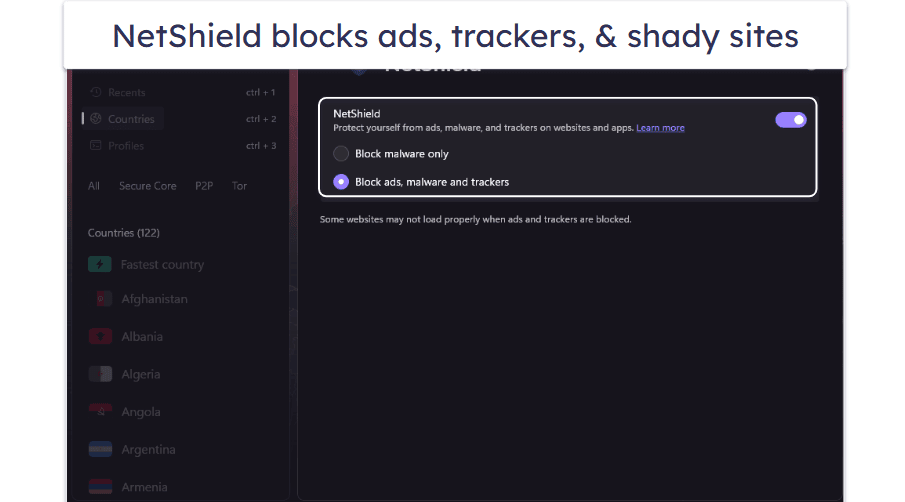
They’re great for browsing Tor, but I prefer Proton VPN’s Tor support — it has special Tor over VPN servers that let you browse the dark web on regular browsers, which is super convenient. If you want to use Tor with Surfshark, you need to download the Tor browser.
Each provider has double VPN connections that route your data through 2 VPN servers instead of 1 server. Surfshark’s MultiHop is very convenient because it allows you to choose the entry and exit point, while Proton’s Secure Core server architecture routes your traffic through 1 regular and 1 server that’s located in an ultra-secure place.
But, only Proton VPN comes with port forwarding, which allows you to connect to more peers for better download speeds. And, only Surfshark has a smart DNS tool that lets you stream on devices that don’t support VPNs, like certain smart TVs and gaming consoles.
Surfshark also comes with these features that Proton VPN doesn’t have:

- IP Rotator: This feature regularly changes your IP address without interrupting your connection to the VPN server, making it super difficult for anyone to track your location.
- Built-in speed test: This tool allows you to run quick speed tests to determine the fastest servers. Unfortunately, it’s not always accurate.
- Override GPS Location (Androids only): This feature aligns your GPS data with your VPN IP address.
Proton VPN has the following unique features that Surfshark is missing:
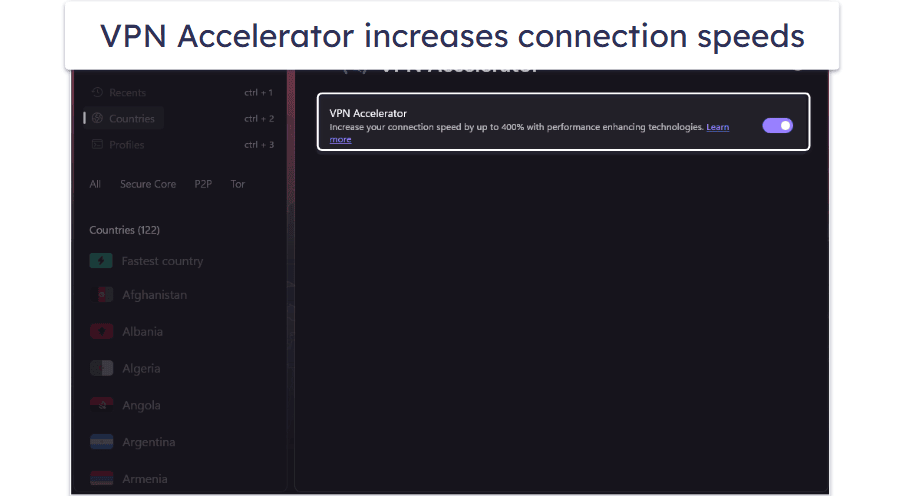
- VPN Accelerator: This technology enhances VPN connection speeds, especially on distant servers. When I connected to servers in the US (I’m located in Macedonia), all websites and videos loaded 2 seconds quicker, which is great.
- Profiles: This feature lets you customize your connections by setting up VPN profiles. For example, you can create a profile that when activated, automatically connects you to a specific type of server (like P2P or Tor servers) using your chosen VPN protocol. You can also name and color-code these profiles for easy tracking.
Winner (Extra Features): Proton VPN
Surfshark doesn’t fall short on extra features, but Proton VPN is simply better. Its Secure Core Servers provide a unique dual-layered security approach, its VPN Accelerator is great for boosting speeds on more distant servers, and the highly customizable Profiles feature gives you greater control over your VPN preferences. And even though both VPNs have Tor support, Proton VPN lets you surf the dark web on regular browsers, which means you don’t have to download the Tor browser.
Privacy — Both Providers Have Great Privacy Features
Surfshark and Proton VPN are very privacy-friendly. They have a strict no-logs policy and don’t log any user data, such as your internet traffic or IP address, and both providers have had their no-logs policy independently audited and confirmed. Surfshark has had its server infrastructure audited, too.

Surfshark is based in the Netherlands, which is a part of the 5/9/14 Eyes Alliances, which is a group of countries that share surveillance data with each other. The good news is Surfshark’s no-logs policy ensures that it wouldn’t have user data to share, even if it receives a request from authorities. Proton VPN’s headquarters are in privacy-friendly Switzerland, which is outside of the 5/9/14 Eyes Alliances jurisdiction.

Proton VPN also has open-source apps. This means anyone can inspect the code for vulnerabilities. Plus, the VPN regularly publishes transparency reports that detail the requests it has received for user data and how it doesn’t comply with them.
Winner (Privacy): It’s a tie
Surfshark and Proton VPN are both very secure options. Although Proton VPN is generally more transparent as it has open-source apps, releases regular transparency reports, and is located in a privacy-friendly country, both VPNs have a strict no-logs policy that prevents them from collecting and sharing any user data.
Servers — Both Have Big Server Networks
Surfshark and Proton VPN both offer a large server network — Proton VPN has servers in 148 countries, while Surfshark has servers in 100 countries.

Surfshark and Proton VPN both have physical and virtual servers. A physical server is located in the country it appears to be in, while a virtual server provides an IP address from the country of choice, but the server itself is located in a different country. I ran a couple of tests to make sure that I’ll be assigned an IP address in the right location when I connect to each VPN’s virtual servers and they always provided me with the correct IP address. I also really like that Surfshark and Proton VPN are very open about their use of virtual locations, as they list them on their sites and clearly mark them in their apps.
In terms of P2P traffic, I prefer Proton— it has a larger P2P network in 148 countries, while Surfshark limits P2P traffic to servers in only 49+ countries. That’s a shame because speed is super important when torrenting, and it’s much easier to get faster speeds if you connect to a nearby server. That said, Surfshark’s servers are well spread out, so you should be able to find a server that’s close to your location in most places around the world.

When it comes to Tor support, I like Proton VPN better. Both VPNs support Tor traffic on all servers, but Proton VPN also has Tor over VPN servers in 5+ countries that allow you to surf the dark web in a regular browser.
But only Surfshark has dedicated IP addresses in 5+ locations, including the US, UK, and the Netherlands.
Winner (Servers): It’s a tie
Both VPN’s server networks are pretty much the same in terms of server locations, although Proton supports P2P traffic in more locations. I like that Proton VPN has Tor over VPN servers, but only Surfshark offers dedicated IP addresses.
Speeds — Proton VPN Is Slightly Faster
Surfshark and Proton VPN are pretty fast VPNs, but Proton VPN is faster. It loaded HD videos on nearby servers a bit faster than Surfshark, and it provided me with faster download speeds, though the difference wasn’t that big.
In my speed tests with Proton VPN, I had great speeds. On nearby servers, Proton VPN loaded all sites and HD videos instantly, and it only took about 1–2 seconds to load 4K videos, which is pretty fast. There were some slowdowns when I connected to more distant servers in the US and Japan (I’m located in Macedonia) — HD videos loaded instantly, but 4K videos took 3–4 seconds to load, and there was minimal buffering at the beginning of the videos.

Surfshark has decent speeds on nearby servers, but there’s a significant drop in speed when connected to far-off servers. On nearby servers, sites and HD videos loaded instantly, and there was no buffering, but once I connected to a more distant server in the US, videos took up to 3–4 seconds to load, 4K videos needed 5–6 seconds to load, and there was noticeable buffering.

Proton VPN also has a VPN Accelerator feature that boosts speeds on distant servers. I tested this tool and was happy to see that it works as advertised — my speeds improved by about 20% when I connected to distant servers.
Winner (Speeds): Proton VPN
Proton VPN wins the speed comparison by a slight edge. It has consistently fast speeds on both nearby and distant servers, and I really like the VPN Accelerator feature, which improved my speeds on more distant servers. In contrast, Surfshark’s speed performance is solid, but it drops off significantly when connecting to distant servers.
Streaming — Each Has Good Streaming Support
If you like to stream, then you can’t go wrong with Surfshark or Proton VPN. They work with popular streaming services, including BBC iPlayer, Amazon Prime, and Max, as well as less popular sites like Crunchyroll, Fubo, and DAZN.

Both providers work well with Netflix. Surfshark is compatible with 15+ Netflix libraries, including in the US, UK, Canada, and Japan, while Proton VPN works with 25+.
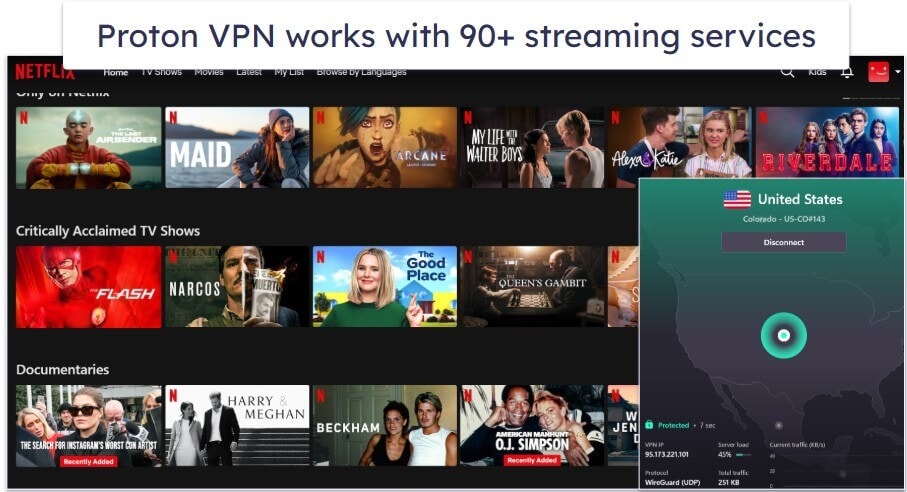
Of the two, only Surfshark has a smart DNS tool that allows you to use the VPN on devices that don’t support VPNs, like certain smart TVs and gaming consoles. However, to use it on your Xbox or PlayStation console, you’ll have to manually set it up on a router, which is less convenient than ExpressVPN’s native router app.
Winner (Streaming): Surfshark
Both VPNs are a great choice for streaming. They work with lots of Netflix libraries and can access top and less popular streaming services. That said, Surfshark is the only one of the two that has a smart DNS tool, which is very convenient when you want to use the VPN on devices that don’t support VPNs.
Torrenting — Both Providers Are Good for Torrenting
Surfshark and Proton VPN have great P2P support and come with convenient features for torrenting. Proton VPN allows torrenting on servers in 148 countries, while Surfshark allows torrenting on servers in 49+ countries — but these are strategically placed around the world, so you’ll be able to find a nearby server to connect to in almost any location.

Both providers also work very well with popular torrent clients. I tested them with qBittorrent, BitTorrent, uTorrent, and Vuze, and I was always able to access and use them without any issues.
However, only Proton VPN offers port forwarding, which lets you get faster torrenting speeds by connecting to more peers. It’s also very easy to use — all you have to do is enable it in the Windows app.

I really like that both VPNs provide excellent security for torrenting. Each has a kill switch, an independently audited no-logs policy, and leak protection. Plus, you get a pretty good ad blocker with each — in my tests, both Surfsharks’ CleanWeb and Proton VPN’s NetShield blocked annoying ads on P2P sites and prevented me from visiting harmful torrenting sites 100% of the time.
Winner (Torrenting): It’s a Tie
I just can’t pick a winner here since both VPNs offer good torrenting support and great security for P2P file sharing. Both Surfshark and Proton VPN allow torrenting, work with popular P2P apps, block ads on torrent sites, and protect you from shady P2P sites. While Proton VPN allows torrenting on more servers in more countries, Surfshark’s torrenting servers are well spread out.
Gaming — Both VPNs Are Solid Options
In terms of gaming, I had a great experience with both Surfshark and Proton VPN. I played a couple of rounds of Dota 2 with each VPN, and I had low ping and no lag with both providers. When I connected to a distant server, I had a slightly higher ping with Surfshark, but it didn’t affect my game — there wasn’t any noticeable lag that could cost me the round.

I like that each provider comes with anti-DDoS protection on its servers. This means that even if someone tries to DDoS the VPN server you’re gaming on to force you to disconnect, they wouldn’t be able to do it.

It’s also great that both Surfshark and Proton VPN have router support, allowing you to safely game on your Xbox and PlayStation consoles. But neither Proton VPN nor Surfshark provides support for cloud gaming. I tested both VPNs with GeForce Now, and they worked fine, but there’s no guarantee it’ll work for you.
Winner (Gaming): It’s a tie
Both Proton VPN and Surfshark are solid options for gaming. They provide stable ping on nearby servers, have DDoS protection, and can be manually set up on a router, which is great if you prefer gaming on your Xbox or PlayStation console. That said, you may experience some lag on more distant servers. The good news is it’s not game-breaking.
Bypassing Censorship — Neither VPN Is a Good Choice
| Obfuscation | Works in China |
Works in Russia |
Works in Iran |
Works in Indonesia  |
Works in Saudi Arabia  |
|
|---|---|---|---|---|---|---|
| Surfshark | ✅ | ❌ | ❌ | ❌ | ❌ | ❌ |
| Proton VPN | ✅ | ❌ | Maybe | Maybe | Maybe | Maybe |
Neither Surfshark nor Proton VPN reliable work in restrictive countries, despite having obfuscation to hide your VPN traffic.

Surfshark’s customer support representatives told me it doesn’t work in China and confirmed that the VPN doesn’t work most of the time in restrictive countries like Saudi Arabia and Russia.
Proton VPN also doesn’t work in China. I talked to a couple of its customer support representatives, and each one told me that some users have managed to get the VPN to work in restrictive countries, but not consistently.

For restrictive countries, I recommend ExpressVPN. It always works in countries like China and Russia, which is why it takes the No. 1 spot on our list of the best VPNs for bypassing government restrictions.
Winner (Bypassing Censorship): None
I don’t recommend either VPN because they don’t consistently work in restrictive countries. Instead, I suggest checking out ExpressVPN, which works very well in places that have limited access to the open internet and limit VPN use.
Apps & Ease of Use — Both VPNs Offer User-Friendly Apps
Proton VPN and Surfshark have excellent platform support that includes iOS, Android, Windows, macOS, Linux, Android TV, Fire TV, and Chromebook.
They also have great mobile apps, which are simple to use. All settings in Proton VPN and Surfshark’s Android and iOS apps come with helpful explanations, and I really like that the VPNs have a Quick-Connect button that connects you to the best possible server based on your location.

Their desktop apps are also user-friendly and feature-rich. I found both very easy to navigate, and I really like that despite the tons of extra features they offer, it’s still simple and quick to find any setting on both their Windows and macOS apps.
They also have good router support and can be manually set up on a lot of popular router models. Plus, they offer detailed tutorials for how to do that on different routers, which is super helpful.
Winner (Apps & Ease of Use): It’s a tie
Both Proton VPN and Surfshark’s apps are beginner-friendly and customizable. They’re easy to navigate, offer helpful explanations for all settings, and their layout is very simple, despite the many extras they come with. Both VPNs also have apps for all major platforms, including Linux, and they work on most routers.
Plans & Pricing — Surfshark Is More Affordable
Surfshark is simply more affordable — it’s one of the cheapest VPNs on the market, and it allows unlimited connections. Proton VPN is slightly more expensive and allows 10 simultaneous connections.
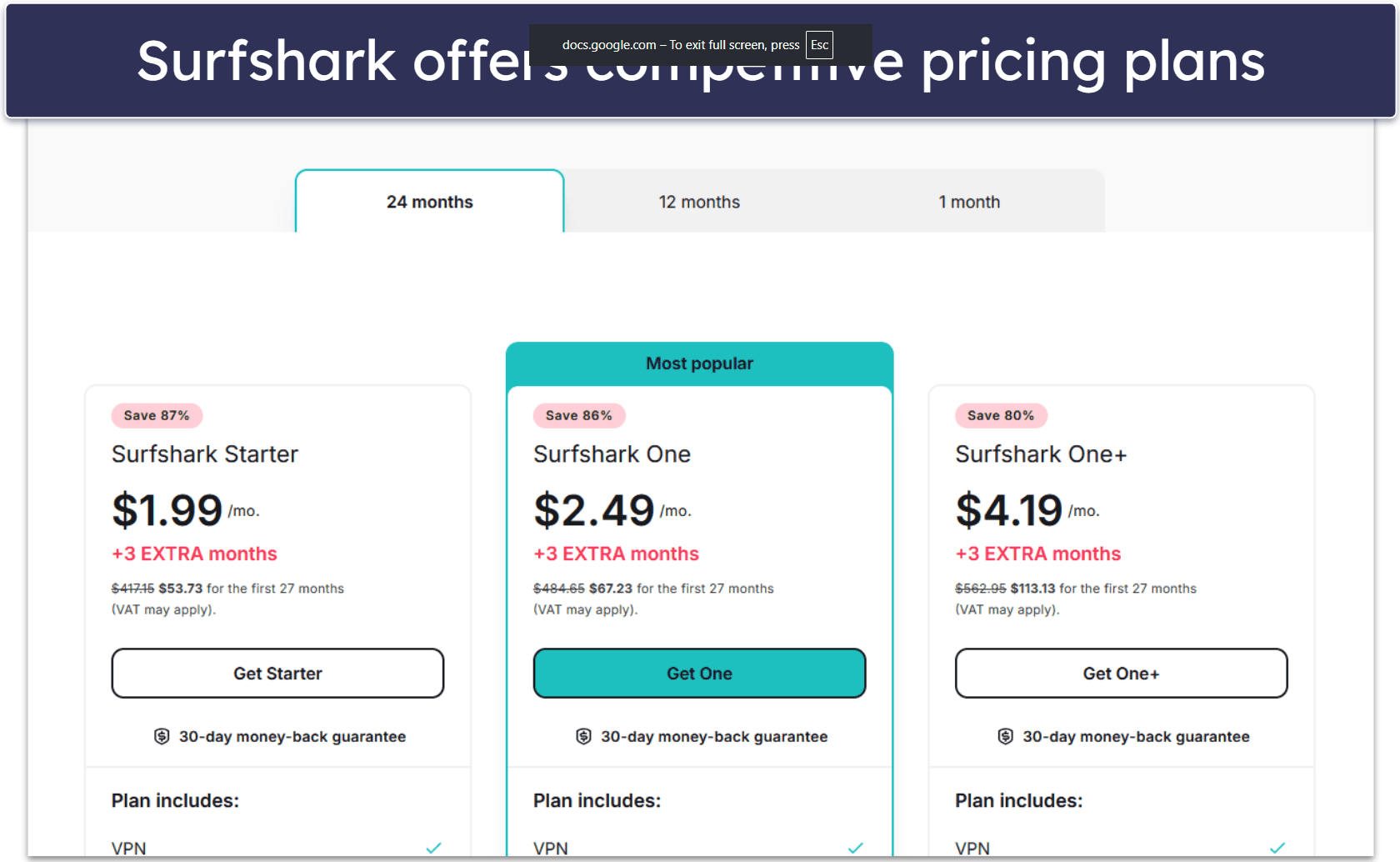
Surfshark has a 1-month, a 1-year, and a 2-year plan. The 2-year plan provides the best value and starts at only $1.99 / month.
Proton VPN comes with a 1-month, a 1-year, and a 2-year plan. Its longest-term plan, which costs $2.99 / month is the best option.
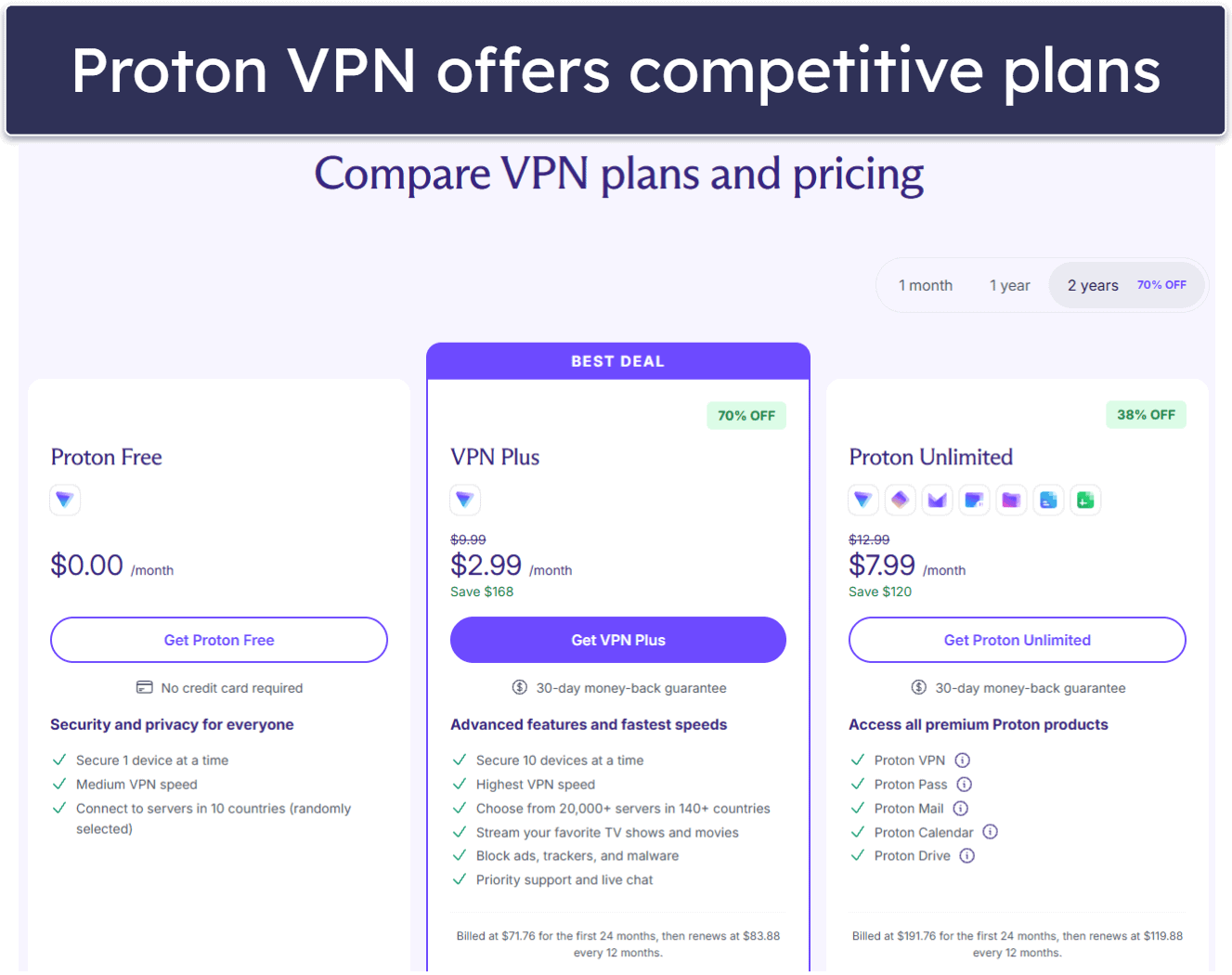
Proton VPN also has a great free plan, which is one of the only free plans you can find that allows unlimited data. It also has great speeds and strong security and privacy features. The downside is that it limits you to 3 server locations: the US, Japan, and the Netherlands. Plus, you only get 1 connection and no streaming support.
Both VPNs accept credit/debit cards, PayPal, and cryptocurrencies. Surfshark also accepts Google Pay and Amazon Pay.
Also, both providers come with a 30-day money-back guarantee — but I like Surfshark’s refund policy better because Proton VPN’s money-back guarantee is prorated, which means it bills you for every day you use it until the 30-day deadline. Surfshark, on the other hand, provides a full refund, regardless of how long you use the VPN in the trial period.
Winner (Plans & Pricing): Surfshark
Both VPNs offer great value, but Surfshark offers pretty much the same for less. All of its plans come with unlimited connections and a 30-day money-back guarantee. Proton VPN, on the other hand, is slightly more expensive, allows 10 simultaneous connections, and has a prorated 30-day money-back guarantee.
Customer Support — Surfshark Has Better Customer Support
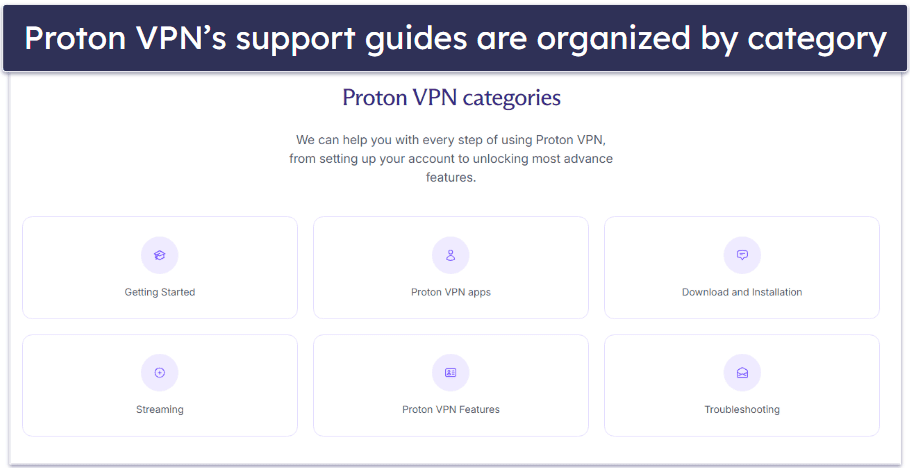
Surfshark and Proton VPN offer comprehensive support libraries, including FAQs, setup tutorials, and troubleshooting guides, all of which are up-to-date. The articles on their sites are detailed and helpful and addressed most of my questions, so there was barely any need to contact their customer support representatives.
However, only Surfshark offers 24/7 live chat support, which is the quickest and most convenient way to get in touch with customer support representatives. I only had to wait for around 10 seconds to get connected to an agent. Plus, Surfshark’s customer support reps are super friendly and knowledgeable, and they always provided accurate and easy-to-understand answers.
Proton VPN offers live chat support, too, but it’s only available Monday through Friday between 9 am–12 pm CEST, and you can’t use it unless you’re a paid subscriber.

Both Surfshark and Proton VPN have email support, but Surfshark’s reps responded to my emails in under a day. Proton VPN’s email support, on the other hand, took more than a day to get back to me.
Winner (Customer Support): Surfshark
Surfshark provides better customer support than Proton VPN. It has 24/7 live chat support, and its email support is slightly faster to respond than Proton VPN’s. But, it’s great that both VPNs provide extensive support libraries and plenty of helpful resources.
Overall Winner: Surfshark
Surfshark has strong security and privacy features, great streaming and torrenting support, excellent speeds on nearby servers, a good ad blocker, and very good customer support that includes live chat.
Proton VPN is very secure, comes with several cool extra features that are convenient, has great streaming and torrenting support, offers excellent privacy, and great speeds.
I really like both VPNs, but Surfshark is slightly better. It has more affordable plans, and offers a full, 30-day money-back guarantee.
Frequently Asked Questions
Can Surfshark and Proton VPN be trusted?
Yes, both Surfshark and Proton VPN have excellent security and privacy features. They come with industry-standard and advanced security features like leak protection and perfect forward secrecy, and each VPN has a no-logs policy that prevents them from keeping any user data (and the policy has been independently audited and confirmed).
What is the disadvantage of Proton VPN compared to Surfshark?
Proton VPN is missing a smart DNS feature, so you won’t be able to stream on devices that lack VPN support, like gaming consoles and some smart TVs. Plus, Surfshark has 24/7 live chat support, while Proton VPN is only accessible during certain hours of the day and only available to paid subscribers. Surfshark’s plans are much more affordable. That said, Proton VPN has more extra features than Surfshark and is one of the only VPNs out there whose apps are fully open-source and audited — I really like the transparency.
Is Surfshark faster than Proton VPN?
Proton VPN is slightly faster than Surfshark. Both VPNs provide speedy connections, but Proton VPN performed better in speed tests, particularly with nearby servers — HD and 4K videos loaded quicker, and I had faster download speeds with Proton VPN. Surfshark was also fast on nearby servers, but there was a noticeable drop in speed when connected to distant servers.
Do Surfshark and Proton VPN work with Netflix?
Yes, both VPNs work with Netflix. Surfshark works with 15+ Netflix libraries, and Proton VPN works with 25+. These VPNs also work with other popular streaming services like Amazon Prime and Max and have pretty good speeds for uninterrupted streaming. Surfshark also has a smart DNS tool, which allows you to watch Netflix on devices that don’t typically support VPNs, like your gaming console.
Do Surfshark and Proton VPN have a free plan?
Only Proton VPN offers a free plan. Proton VPN’s free plan is one of the rare VPNs that comes with unlimited bandwidth. This makes it a good option for users on a budget or those who wish to try out the service before upgrading.
However, Proton VPN’s free plan is pretty limited in terms of features and the number of servers. Proton VPN only allows access to 5 server locations on its free plan: the US, Japan, Romania, Poland, and the Netherlands. The free plan also lacks streaming support and doesn’t support torrenting.
Surfshark only offers a paid service, but it does provide a 30-day money-back guarantee, so you can try it risk-free. Proton VPN also backs its paid plans with a 30-day money-back guarantee, but it’s prorated.