

Published on: February 19, 2025 Updated 2 times since publishing
In this new interview by SafetyDetectives, we have Tim Flower, DEX Strategist at Nexthink, and 35-years veteran in enterprise IT. He is also an author and co-host of The DEX Show, a podcast dedicated to discussing advancements in digital workplace experience, where he engages with industry experts to explore trends and challenges in DEX management.
We asked Flower to dive into how DEX (Digital Employee Experience) optimizes IT efficiency, improves security, and redefines the employee experience—making it “the bacon” of enterprise IT.
Tim, you’ve been with Nexthink now for almost 10 years – Tell us a bit about your role and the company?
When I started at Nexthink in the US, there were only about a dozen employees here working to expand the Swiss-based company into the states. And after being a customer, coupled with 25 years of EUC experience at the time, I had some skills that were tough to find in the software industry. So I started by putting together the foundations of a customer success plan to help existing customers chart a path to success as I had done.
I also scaled out the business case and ROI methodologies that I had used internally to justify the software purchase so our sales teams and the prospects they were working with could justify their future purchase.
And I took to the road with reps on individual sales calls, spoke at industry events, hosted webinars, and wrote articles for our blog site.
I then expanded those accountabilities company-wide, took on a Sales Enablement leadership role for a bit, until today where my role is solely focused on strategy and evangelism with prospects, partners, and customers:
- I travel around the world spreading the news about proactive IT at events
- I visit prospects to do the same 1:1 (and continue to do some writing)
- I also co-host our podcast called The DEX Show
- I also have a short book out called DEX for Dummies, now at its 2nd edition
It’s actually the greatest job on the planet with the best company on the planet.
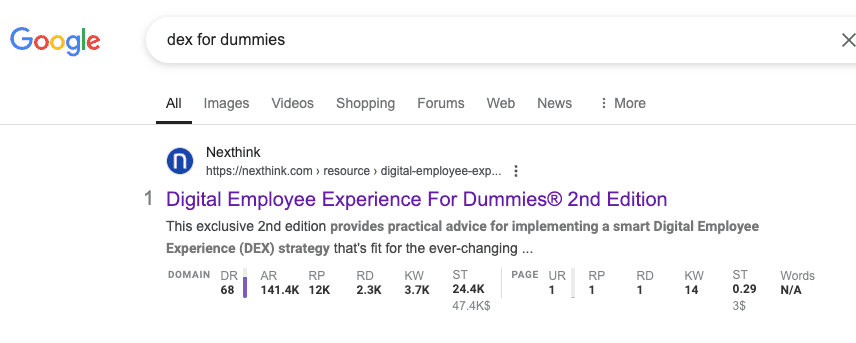
🔎 To read more from Tim Flower Google DEX for Dummies
And with your 35+ years of EUC experience, what is DEX and how does it fit into the hierarchy of enterprise IT platforms?
Proactive IT (it wasn’t known as DEX yet) was a unique finding for me back in 2013, giving me and my teams visibility at the endpoint we never knew was possible, coupled with AI analytics and automation. And then Nexthink coined the term DEX and the IT discipline to go along with it.
While it doesn’t replace any specific tool or platform, DEX provides insights and abilities across a wide array of IT disciplines and functions. It’s kind of like bacon – you can add it to anything and immediately make it better.

1. It makes you better at being reactive.
Don’t try to tackle too much too soon. Rather, look to make your existing teams and processes better, faster, and cheaper. With the right visibility, you can cut through all the interrogation that our employees hate and also see exactly what’s happening in their world to get to root cause solutions faster, while also minimizing ticket bounce.
2. It allows you to move from purely reactive to proactive IT
This creates enterprise stability, reliability, and predictability, which all contribute to enterprise productivity for employees. The combined value to IT and the business is astronomical, providing insights into not only how employees are consuming technology, but where their daily hurdles are and what speedbumps exist that IT needs to prioritize.
These can range from small nuisance issues to large scale, business-impacting outages where IT can identify the full scope of the problem, prioritize the work, and shorten the time to resolution – all without depending on employees to call the help desk. And these issues don’t need to be specific to an endpoint – it can be network bottlenecks, server response times, or even SaaS performance and availability. It also means enhanced visibility into hardware and software usage and right sizing the environment for the role and persona.
3. It provides security teams visibility into their security posture
It helps you look into the myriads of agents installed in devices and sessions, and whether or not those agents are up and running, functioning properly with the right updates, and not impacting the employee experience.
4. Moving to preventative IT
DEX gives you the ability to know in advance if something will be a problem for employees and avoid the issue altogether. This step of avoiding issues is critical for enterprise health and productivity. It’s the difference between quickly curing a cancer to completely preventing it. With cloud insights of 20 million other devices and the ability to assess the impact of a change you haven’t even made yet. With the right platform, you can even include your VDI and Citrix environments to understand the implications to virtual configurations as well as physical before they impact employees. And the ability to use AI-based workflow automation to keep configurations standard and automate service requests. This includes elements of the security world where real time detection and remediation of protective requirements is critical.
5. Provides insights into the adoption of technology by employees
The visibility today of just deployment and some usage stats is too limited. Deep understanding of where employees are struggling inside an app, the ability to guide them with context-sensitive prompts and learning aids, both provide information and collect important feedback from employees, and deliver technical feedback to IT where the application bottlenecks are, all serve to help application owners provide continuous enablement rather than just point in time training.
So, I guess the short answer is that it fits just about everywhere in the IT hierarchy.
So with that foundation, why does DEX matter for cybersecurity and what missing piece does it solve?
Security is so complicated these days, with so many vectors of attack and so many worldwide bad actors that it’s tough to know where to start. It’s easier to start from what DEX is not…
DEX is NOT a replacement for any one security posture or capability. What it provides is a unique ability to see what’s happening not only on the device, but in the ecosystem the device interacts with.
So, starting with the device, DEX can ensure that agents are functioning properly and have all the proper updates. And if something isn’t right, it can take immediate action based on the real time findings. Restart an agent. Turn on a firewall. Kickstart an update. Remediate a failed client patch management agent. Notify the employee of action taken or needed.
And with those insights it can also pick up on employee behavior, like failing to reboot after a critical update, or keeping their device powered up for too many weeks in a row. And on technology behavior, like two security agents that are in conflict and causing an impact to the employee experience.
And with real time visibility into everything that is running on and in communication with the device, it can see anomalies in execution or data transfer that break outside the normal routines of the employee to allow for alerts and investigation.
To what extent would you say the employee experience has traditionally been impacted when it comes to managing enterprise security?
Enterprise security has one job – protect business and customer assets through the prevention of intrusion or data leakage.
In that neverending quest of protection, there can be collateral damage to employees with unintended and invisible performance issues or outages. Agents can collide, updates can fail (can you say CrowdStrike?), or broken security postures can lead to intrusion and employee impact. And much of this is either up to the individual security platform to manage itself or go completely unresolved through a lack of awareness.
Can you give us some tangible examples of how cybersecurity teams can benefit from DEX?
There are countless ways for DEX to benefit security teams:
- They can setup client agent dashboards to keep watch on endpoint health
- Create alerts for critical behaviors and known anomalies
- Develop workflows to remediate agents or employee behavior on the spot.
Moreover, having comprehensive DEX analytics allows security teams to save huge amounts of time and finger pointing when escalating issues to vendors with specific proof of agent impact, scope, and timeframes.
Finally, teams can assess and test changes prior to deployment as well as accelerate patches and other updates with increased confidence and immediate issue detection.
What most excites you about the potential of combining DEX and security in the coming years?
EUC is the entry point for almost all security breaches, and the advancements of AI coupled with real time visibility and workflow automation at the endpoint will bring some consolidation of capabilities to the enterprise and allow for some unique protective functions to emerge.
Employee education and adoption of security requirements, anomaly detection and removal in real time, data breach detection especially with rogue (or approved) AI tools , and a whole host of other security-related elements will, like bacon, be made even better when augmented with DEX.
How can people connect with you?
LinkedIn: @TheProactiveITGuy
YouTube: @TheProactiveITGuy
Nexthink: DEX for Dummies
Podcast: The DEX Show