

Published on: May 25, 2026 Updated 2 times since publishing
Checking your privacy settings, using strong passwords, and being selective about what you share online is digital caution, and it’s well worth practicing. But for some people, that caution becomes detached from reality. They can be overwhelmed by a sense that the apps and platforms they use — and the people they interact with online — can’t be trusted. They assume their devices are working against them, even without evidence.
Digital paranoia is increasingly common and it’s driven by real problems — data breaches, surveillance scandals, algorithmic tracking — that are easy to overestimate and hard to put in perspective. This guide breaks down what digital paranoia is, what causes it, how to spot it, and what you can do about it.
What Is Digital Paranoia?
Digital paranoia is an extreme, irrational anxiety or suspicion that the technology, social media, and digital devices we interact with daily are tracking, targeting, or manipulating us.
Fear of online threats sits on a spectrum, from reasonable caution to persistent, irrational dread that goes beyond any evidence of a realistic threat. Here’s how experts define digital paranoia and how it differs from related conditions.
Defining Digital Paranoia
Digital paranoia is a persistent, irrational, and intense suspicion that digital technologies are being used to invasively watch or exploit users, without real evidence to support the beliefs. Researchers at University College London initially coined the term “cyber-paranoia” to describe these unrealistic fears about “threats via information technologies.”
Their study found that cyber-paranoia sits somewhere on a spectrum alongside more “realistic” digital fears, though still distinct enough to warrant its own category. This primarily correlates with so-called general trait paranoia, lower digital literacy, and older age.
Another study reinforced these findings. In the general population, older and less tech-savvy participants scored highest for cyber-paranoia, while frequent internet users and IT professionals scored lowest. Both papers came to the same conclusion: the more a person knows about technology, the less likely they are to fear it irrationally.
Pre-existing mental health conditions raise the risk further. Research links this kind of paranoid thinking to anxiety, depression, OCD, past trauma, and psychotic disorders. All these conditions can amplify how someone interprets digital risks. Adolescents dealing with bullying or cyber-victimization also show higher rates of persistent paranoia, suggesting that negative online experiences during earlier years can impact long-term digital mistrust.
So the question is, “Where’s the line between caution and paranoia?”
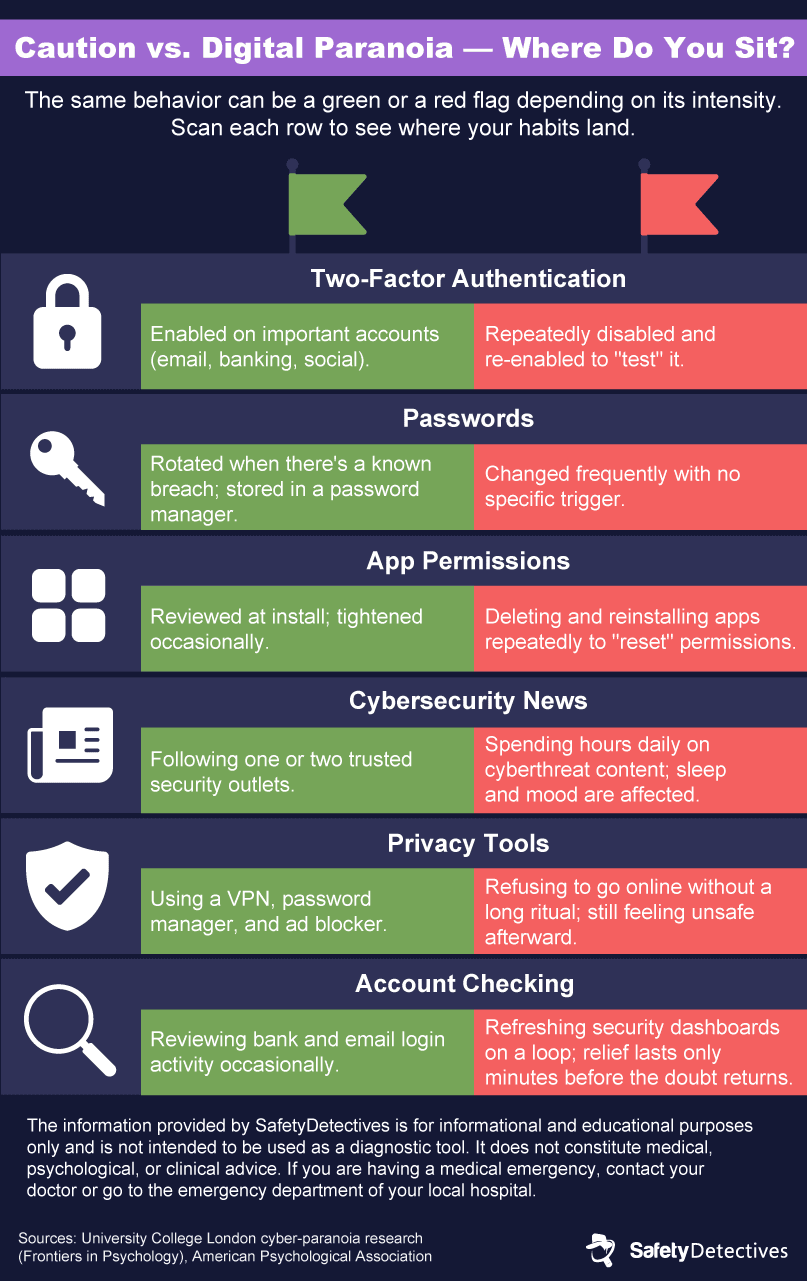
Healthy digital skepticism is grounded in evidence and can lead to useful actions, such as using two-factor authentication and strong passwords. Digital paranoia involves disproportionate fear without a rational basis, such as believing you’re being surveilled by the government despite having no reason to be targeted.
Digital Paranoia, Technophobia, and Cyberphobia
Digital paranoia, technophobia, and cyberphobia sound similar but describe different things:
Digital paranoia, technophobia, and cyberphobia can also overlap. Someone with technophobia might develop paranoid thoughts about surveillance, for example.
Causes of Digital Paranoia
Digital paranoia rarely stems from one thing. More often, several factors work together — for example, genuine online risks, personal vulnerabilities, and an online media landscape that blurs the line between the two.
The Prevalence of Cyberthreats
Underlying the issue is the fact that cyberthreats are very real. In 2024 alone, the Identity Theft Resource Center tracked 3,158 data compromises, and the World Economic Forum flagged ransomware, social engineering, and AI-driven cybercrime as leading threats in its 2025 outlook.
When stories about compromised accounts and stolen identities are all over the news cycle, the fear of becoming a victim can start to feel more certain. The jump from “this could happen to anyone” to “this is happening to me” can become a short one.
Mental Health and Pre-Existing Conditions
If you already live with anxiety, OCD, depression, or trauma, the digital world offers plenty more things to worry about. These conditions can even shape how you interpret ambiguous signals. A slow-loading page? Evidence of tampering. An unfamiliar login notification? A trigger for hours of panicked account auditing.
OCD can be particularly relevant here. Research into compulsive checking shows that people who feel an exaggerated duty to prevent harm are more likely to get stuck in repetitive loops, like refreshing security dashboards, re-reading privacy policies, or Googling whether a specific app is “safe” over and over again. Unfortunately, the checking doesn’t resolve the anxiety, but feeds it.
Cognitive Biases
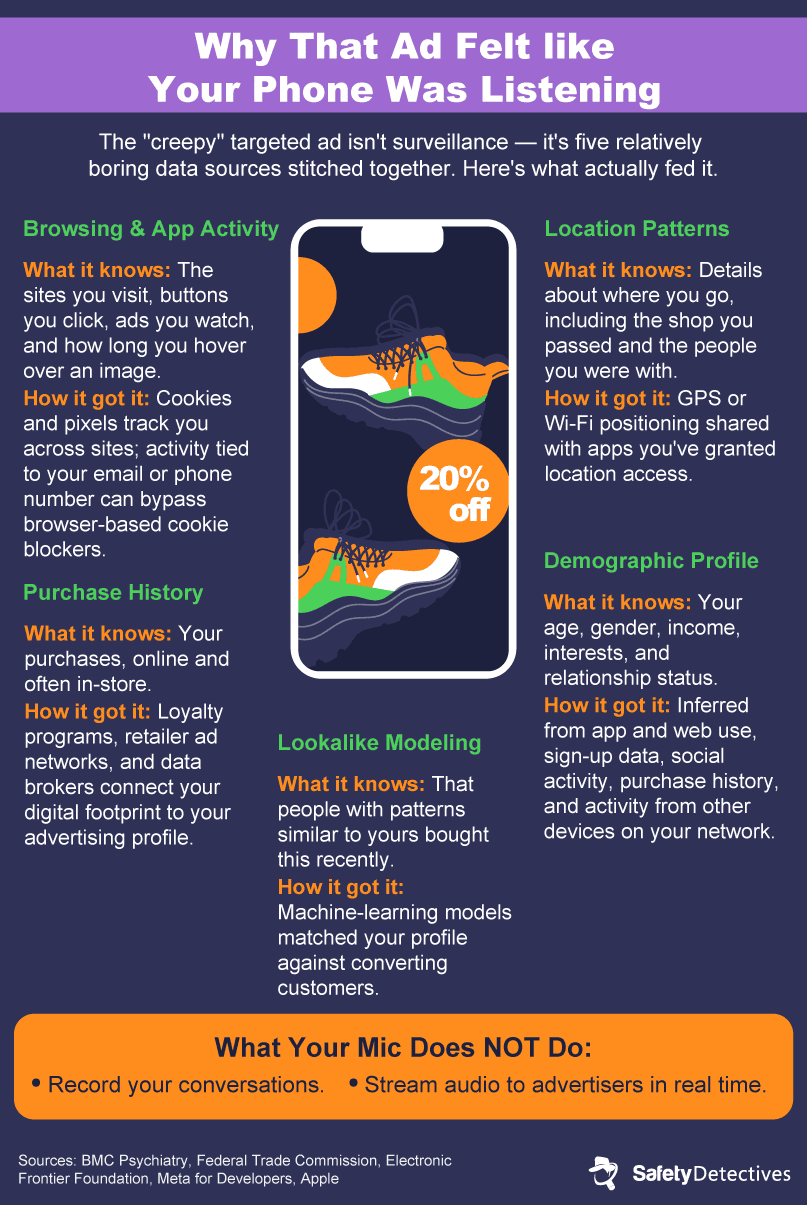
Our brains don’t analyze risk neutrally. Confirmation bias pushes people toward evidence that validates their fears and away from evidence challenging those fears. For instance, if you suspect your phone is eavesdropping, a well-timed targeted ad feels like proof, even if the likeliest explanation is that an algorithm tracked your recent browsing or purchase history, or your location showed you near someone who had purchased the item in the ad.
Negativity bias compounds this, since we’re hardwired to focus on threats more heavily than reassurances. This means that one alarming headline about a data breach can outweigh dozens of routine security reports that confirm your accounts are fine.
Media and Social Media
News outlets love to lead with the most dramatic cybersecurity stories — it gets the most eyeballs on their content, which is all they want. High-profile events like the Cambridge Analytica scandal and the Snowden disclosures were covered in huge detail at the time, and reshaped how millions of people felt about technology and its dangers. The psychological impact of these stories can outlast the news cycles by years.
Social media adds another layer. The platforms themselves profit from collecting detailed behavioral data, and the ads resulting from this can feel strangely precise. When you see an ad for something someone mentioned to you in conversation, the simplest explanation — algorithmic guessing based on your activity patterns — is less intuitive than the paranoid one: “my phone is listening.”
Misinformation and Conspiracy Theories
Conspiracy theories exploit the same anxieties that drive digital paranoia — and then amplify them. During the COVID-19 pandemic, for example, false claims linking 5G technology to the virus led to protests and even physical attacks on cell infrastructure — all based on fabricated evidence.
People already experiencing paranoid thinking are disproportionately drawn to conspiracy theories, according to the American Psychological Association. Worse, buying into these theories doesn’t ease the root fear, but tends to deepen it, creating a cycle in which each new theory validates the fear and demands another.
Lack of Technical Understanding
This may be the most common — but also the most fixable — cause of digital paranoia on our list. If you don’t understand how data collection, ad targeting, or encryption work, many more minor technical issues can look like a potential threat. A person who can’t distinguish between a routine cookie consent banner and a genuine privacy risk will likely treat everything as dangerous.
The University College London research discussed earlier found that less familiarity with technology equaled higher levels of cyber-paranoid thinking, while greater digital literacy and hands-on experience brought those levels down. People who used the internet more frequently and across more devices consistently reported lower cyber paranoia than those who didn’t.
Effects and Symptoms of Digital Paranoia
Digital paranoia influences how people who suffer with it behave, feel, think, and perform at work. Before a person can work on solving these patterns, they need to be able to recognize them.
Behavioral Signs
Paranoid thinking tends to produce compulsive and protective behaviors — actions that feel necessary in the moment but serve no real security purpose. In the context of digital paranoia, this could look like:
- Repeatedly deleting and reinstalling apps over vague safety concerns.
- Toggling Wi-Fi, Bluetooth, or location services on and off throughout the day.
- Spending hours adjusting privacy settings or researching whether a service can be trusted.
- Refusing to use online banking, cloud storage, or any platform that requires personal data.
- Believing conspiracy-based explanations of how the internet works.
These behaviors often function as coping mechanisms and are an effort to give the sufferer a greater sense of control. Unfortunately, they rarely resolve the underlying fear, and generally only serve to keep the cycle going.
Emotional Signs
The emotional toll of digital paranoia mirrors more general paranoia in many ways. A constant distrust of platforms, companies, and even the people you communicate with online can leave you feeling isolated and on edge. You might notice:
- Ongoing anxiety or restlessness: You might feel on edge whenever you’re online, anxiously awaiting a breach notification or suspicious email. Even routine tasks like checking your inbox can carry a low-level dread that something’s wrong.
- Difficulty sleeping: Especially if you think of digital threats before bed. Research shows that paranoia and poor sleep reinforce each other, and the cycle can be hard to break once it starts.
- Low mood or depressive feelings: A sense of helplessness about staying safe online, especially if you feel like nothing you do is ever enough.
- Growing reluctance to interact online: Staying quiet in group chats, social media, or over email out of fear rather than preference.
- Feeling targeted or persecuted: A persistent feeling that specific actors — Big Tech, the government, hackers — are paying attention to you in particular.
Over time, this withdrawal can strain relationships. If you treat every link shared with you as a phishing attempt, the people around you are likely to feel distrusted, even if your behavior has nothing to do with them personally.
Cognitive Signs
When looking at the cognitive signs of digital paranoia, three patterns stand out:
- Catastrophizing: Jumping to terrible conclusions from minor or even ambiguous events. A password reset email becomes proof that your account was breached. A new app permission request means the company is harvesting everything on your phone. Every small trigger mentally escalates into a full-scale threat.
- Hypervigilance: A state of constant alertness for digital threats that leaves you mentally exhausted. You scan every notification, inspect every URL, and second-guess every online interaction.
- Repetitive checking: Compulsively verifying that accounts haven’t been compromised, no settings have changed, or that no one has accessed your files. Unlike a one-time security audit, this checking happens on a loop and provides only temporary relief before the doubt creeps back in.
Professional Consequences
Digital paranoia can follow you to work. Worrying 24/7 can drain your mental energy and focus, make deadlines harder to meet, and increase mistakes you otherwise wouldn’t make. Research into cybersecurity fatigue found that the mental load of constant security tasks lowers output quality.
It makes communication suffer too. If you think you can’t trust email, shared documents, or other collaborative platforms, you can create friction with colleagues which could lead to larger issues with your work. In severe cases, the anxiety can lead to skipping work entirely to avoid environments where you feel digitally exposed.
Common Myths and Misconceptions
Much of digital paranoia comes from misunderstanding what’s actually happening behind the screen. Some widespread fears have a grain of truth, while others should be ignored. Knowing the difference helps you focus your energy on real risks and let go of any that aren’t worth worrying over.
Tips and Tools to Overcome Digital Paranoia
Knowing what drives digital paranoia will help you avoid it. The following tips — from building technical knowledge to breaking the cycle of negative thought patterns — address the most common causes.
1. Build Digital Confidence
The more you understand how technology works, the less likely you are to irrationally fear it. You don’t need a degree in cybersecurity — even a basic understanding of how your data is moved and stored online can reduce a lot of fear.
Learn the basics of data collection, tracking, and online security. For instance, understanding that a targeted ad is simply driven by cookies and browsing patterns (as opposed to a wiretap) gives some clarity on what could otherwise be a sinister-feeling experience.
These free courses are a good starting point:
- Introduction to Cybersecurity — Codecademy
- Cybersecurity Education Courses — Palo Alto Networks
- Introduction to Cybersecurity — Cisco
Not all cybersecurity coverage is equally reliable. Sensationalized reporting and “rage-bait” social media posts can twist your sense of how at-risk you really are. Curate a list of established outlets and journalists with a track record of accurate, “matter-of-fact” reporting (Reuters is one outlet known for this), and avoid less credible sources. You can even mute specific keywords or block accounts on social platforms to filter out noise without going completely offline.
Try to differentiate scare tactics from real warnings. Scare tactics rely on emotional pressure, including urgency and vague threats. A genuine security alert will tell you exactly what happened, who’s affected, and what to do. If a headline or post makes you feel panicked but offers no actionable information, that’s a red flag.
Know which threats are real. Many digital fears are rational. Abusive partners do use stalkerware to track victims’ locations and messages, authoritarian governments do conduct mass digital surveillance, and many companies do request to track more of your data than they need. Recognizing genuine risks is the opposite of paranoia, but informed caution.
2. Set Boundaries with Technology
Constant exposure to worrying content reinforces paranoid thinking. Ensuring you have deliberate breaks in your routine helps interrupt that cycle.
Limit doomscrolling. Many social media apps now let you set daily time limits (or you can set limits in your phone’s main settings). Turn off push notifications for news apps so you check in on your own terms rather than reacting to every alert. If you notice yourself spiraling through privacy horror stories, step away. As a last resort, uninstalling these apps entirely (even temporarily) can be a welcome reprieve.
Schedule offline time. This could be during meals, before bed, or on walks, with the aim of reducing the compulsive checking behavior associated with digital paranoia. This compulsive checking is a “maladaptive coping mechanism” — a behavior meant to reduce stress, but which only ends up contributing to anxiety and insecurity.
The goal of these choices isn’t to avoid technology permanently, but to prove to yourself that disconnecting for a few hours doesn’t put you at any risk.
3. Use Tools Wisely
Privacy and security tools can reduce your exposure to online threats, but only if you understand what they do and don’t protect against.
- A VPN encrypts data leaving your device and hides your IP address from sites you visit. This is valuable on public networks and for preventing your ISP from logging your browsing.
- Ad blockers prevent many third-party tracking scripts from loading. This makes it harder for advertisers to follow you across sites.
- Encrypted browsers like Brave, Firefox (with privacy extensions), or LibreWolf reduce fingerprinting and block trackers by default.
Note that these tools work best in combination with good habits, such as:
- Strong, unique passwords stored in a password manager.
- Two-factor authentication on important accounts.
- Keeping your operating system and apps updated.
No single tool makes you bulletproof, but layering a few of them together with better informed behavior covers most of the risks you might face as an ordinary user.
4. Train Your Mind
If digital paranoia is interfering with your daily life — disrupting sleep, damaging relationships, or making it hard to focus — consider professional support.
Talk to a therapist. Look for practitioners with experience in treating digital-related anxiety disorders. Cognitive behavioral therapy (CBT) is especially effective for paranoid thinking because it directly targets the distorted thought patterns driving the fear. A therapist can help you identify core beliefs (like “I’m always vulnerable online”) and work toward better alternatives.
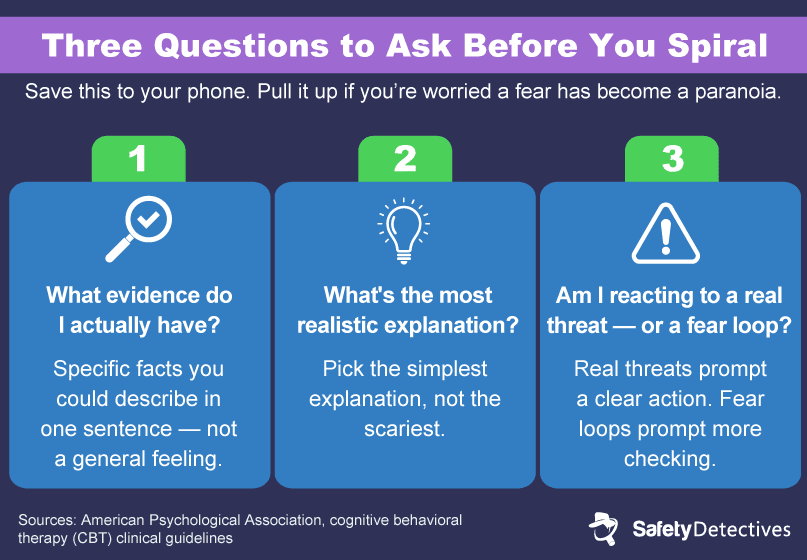
Try cognitive reframing on your own. When a paranoid thought hits, go through three simple questions: What evidence do I actually have? What’s the most realistic explanation? Am I reacting to a real threat or a fear loop? This won’t prevent the anxiety, but it builds a habit of pausing and considering before spiraling into worse thoughts.
Mindfulness and grounding exercises. When fear takes over, try stepping away from your screen and ground yourself — focus on your breathing, notice what you can physically see and hear around you, or step outside briefly. Building a regular mindfulness habit also trains you to catch anxious thoughts early and let them pass rather than acting on them.
Journal your triggers. Writing down what set off a paranoid episode can help you spot patterns over time. This could be a specific notification, news article, or conversation, and once you can identify a common trigger, you can plan for them instead of being ambushed by them.
Stay Grounded in a Connected World
Digital paranoia is common, and with the state of online privacy and security, sometimes even understandable. But letting fear dictate your relationship with technology rarely helps you, and often does more harm than good.
You don’t need to quit the internet or wrap your phone (or yourself) in tinfoil. However, it’s worth understanding what’s actually dangerous, taking proportional steps to protect yourself, and recognizing when your thinking has moved from caution into something less productive. If that shift has already happened, the tools and strategies in this guide are a good place to start — and professional support is always an option if you need it.
Technology isn’t going anywhere, and learning to use it without fear is worth the effort.
FAQs About Digital Paranoia
Digital paranoia can affect a person’s relationships with the technologies that are increasingly becoming a part of our everyday lives, as well as with the people they love. We answer some of the most frequently asked questions about dealing with this disorder.
What is digital paranoia, and how is it different from normal privacy concerns?
Digital paranoia is a persistent, disproportionate fear that technology is being used to surveil, take advantage of, or harm you — with no evidence to support the belief. While normal privacy concerns lead to reasonable actions like using stronger passwords, digital paranoia goes beyond that. The fear itself drives avoidance, compulsive behaviors, and ongoing distress regardless of what precautions you take.
What triggers digital paranoia in today’s online environment?
Some of the most common triggers of digital paranoia include:
- Frequent news coverage of data breaches and surveillance.
- Personal experiences with being scammed or hacked.
- Pre-existing anxiety or trauma.
- Algorithmic ad targeting that feels invasive.
- Social media and misinformation that worsen existing fears.
- A general lack of understanding about how technology handles your data.
All the above can individually contribute, although there’s also frequent overlap between factors.
How can I tell if my fears are justified or irrational?
To determine if your fears are justified, you can ask yourself:
- Do I have specific evidence for this fear?
- Is my response proportional to the actual risk?
If the answer to one or both of these questions is no, there’s a good chance you’re suffering from some level of digital paranoia. If your fears persist regardless of the precautions you take, or if they’re interfering with daily life, that’s a strong signal to seek support.
What are simple steps I can take to reduce digital paranoia?
To reduce symptoms you might have of digital paranoia, you can:
- Build your digital literacy.
- Gaining some education can help — see the resources linked previously in this article.
- Use practical security tools.
- Use a password manager, set up two-factor authentication on your accounts, and use a reputable VPN.
- Set boundaries with news and social media to avoid doom-spiraling.
- You can use time-limiting features in many modern phones and apps to block access after a set amount of time.
- If anxious thoughts about technology are disrupting your routine, try cognitive reframing techniques or speak with a therapist who understands anxiety in a digital context.
The content provided by Safety Detectives is for informational and educational purposes only and is not intended to be used as a diagnostic tool. It does not constitute medical, psychological, or clinical advice. If you or someone you know is struggling with paranoia, distressing thoughts, or emotional difficulties, please consult a qualified mental health professional for an appropriate assessment and care. If you are having a medical emergency, contact your doctor or go to the emergency department of your local hospital.
Important: SafetyDetectives owns the content and visuals in this article. We encourage you to share our content and visuals, provided you include a mention of SafetyDetectives with a link to the original article as the source. We appreciate your help in protecting our copyrights and enabling us to continue providing accurate and valuable information about cybersecurity.